
The Art of Subtraction
Why your brain craves less in the frame, but you struggle to achieve it

Reducing the context to focus on the Saharan Crocodile in the setting sun, Mauritania
Most art forms are additive.
A painter begins with a blank canvas and adds pigment, layer by layer, until a world is born.
A writer starts with a white page and adds words until a narrative takes shape.
Photography is the only creative pursuit that is fundamentally subtractive.
When you raise your camera to your eye, you don’t start with nothing. You are starting with the entire, chaotic, infinite reality of the world. And it is your job to decide what to put in and more importantly, what to leave out.
Over time I’ve come to realise that one of photography’s biggest barriers to impactful work - work that people can feel - is well, our own mind. You see it has FOMO. It simply doesn’t want us to remove things from our frame.
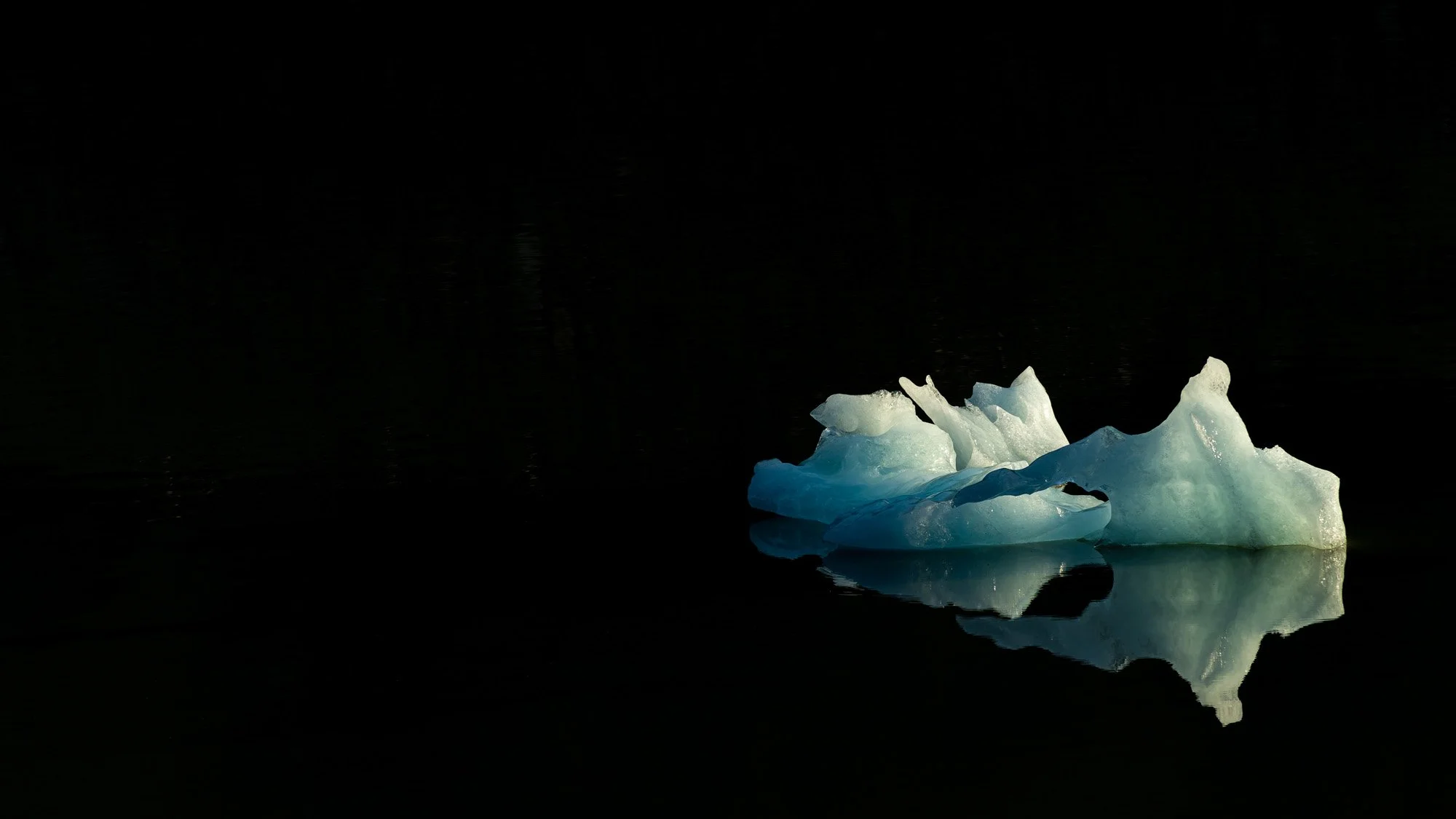
A photo of subtraction - inky blackness and just the remains of glacial ice, Patagonia
The Human Glitch
Why is it so hard to take a simple photograph? Why do we feel the need to include the mountain, the river, and the sunset all in one picture?
The answer lies in a phenomenon called Addition Bias. A landmark 2021 study [Nature] proved that when humans are asked to improve a design or solve a problem, our brains default to adding elements, even when subtracting is measurably more effective.
We have been conditioned to believe that 'more' equals more value. In photography, this manifests as visual clutter. We treat our sensors like vacuum cleaners, trying to suck up every pixel of light and detail. But the truth is, more 'data' doesn't lead to more 'meaning'. In fact, it’s often the reverse, it dilutes the message and confuses the viewer.
If your images feel flat, it's because there’s too much going on.
Master simplicity with the Signal In The Frame.

Simplify the frame - a branch, a bird and nothing more, The Gambia
Less is More
To understand why a cluttered photo fails, we have to understand how our brain is wired. The human visual system has a limited bandwidth—we can only actively process about four to seven 'chunks' of information at any given time.
Every extra element in your frame—a stray branch, a distracting neon sign, a messy background—is forcing the viewer’s brain to do more work.
When you subtract, you are not making the image ‘less’, you are strengthening the signal you want to share whilst reducing the noise. By removing the unnecessary, you increase the ability of the viewer to process your image more fluently.

Saying less and feeling more with the Himba, Namibia
The Mental Skeleton
In Gestalt psychology, the Law of Prägnanz states that the brain will naturally organise complex images into the simplest form possible. Your visual system is constantly "pruning" reality, desperately searching for a skeleton of order in a graveyard of noise.
The mistake I see many photographers make is not thinking enough about that ‘pruning’ behind the lens, and forcing the viewer to do it themselves.
When you consciously strip away you reveal the mental skeleton of your work. You are handing the viewer’s brain a ‘signal’ that is already pre-digested. I’ve found the images that resonate aren't the ones that show the ‘most’; they are the ones that have been pruned until only the most essential remains.

Highlighting the power of Iguazu Falls, Argentina
The "So What" for the Photographer
The greatest trap in photography is the belief that an empty frame is a wasted frame. We often feel a subconscious pressure to fill every corner with "data," as if leaving a void were an act of laziness rather than discipline.
Resist the urge to fill.
The next time you find yourself in front of a beautiful scene, don't ask what you can add to the frame. Ask: "What else can I take away?"
Spatial Subtraction: Get closer. Use Robert Capa’s rule: “if your photos aren't good enough, you aren't close enough”.
Chromatic Subtraction: Remove the emotion of colour. Black and white is the ultimate subtractive tool, forcing the brain to focus entirely on light, form, and texture.
Depth Subtraction: Use a wide aperture to blur away the noise. Turn a chaotic background into a soft wash of colour that provides zero resistance.
A picture of everything is a picture of nothing. A picture pruned is a picture with purpose.
Cliff is a Visual Ethnographer using psychology to capture the unvarnished reality of the human condition. If you are ready to stop documenting what things look like and start capturing what they really mean, get the Signal in the Frame blueprint. Join the expedition on YouTube here.

Silhouettes and orange light, Morocco