
Why every photo you take reveals more about you than your subject

A portrait of a barrel-maker artisan. But what does it say about me?
Sully, my Land Rover is currently undergoing much needed TLC in preparation for the next photographic adventure. In the meantime I’m digging back through hard drives from the last decade of expeditions.
I was looking at contact sheets from two very different trips. The first was a crossing of the Sahara Desert—vast, empty, scorching. The second was navigating the high peaks of Montenegro.
As I scrolled through the grids of raw files, an unsettling pattern emerged.
During the first weeks in the Sahara, so many of my frames were tightly cropped on the chaos of the Land Rover, the gear, the details of the sand. It wasn't until week three that the frames opened up into massive, sweeping negative space.
Conversely, in Montenegro, my earliest frames were surprisingly ordered and structured, despite the chaos and challenge of the mountains. It wasn’t until we’d struggled over a pass - and the weight had lifted from my shoulders - that I could see a more open interpretation of the country come through my work.
The environment hadn't changed. The only variable that shifted was my own psychology.

The adventure through the mountains of Montenegro
The "Objective" Lie
Whilst technology changes things, I feel many people see photography as an "objective truth". It’s not like a painting or sculpture where someone creates something from nothing, you are ‘simply’ capturing what is in front of you.
But, you - the photographer - are not a surveillance camera. You are complex and flawed. Brilliant but still flawed!
When you step into an environment, you do not see an objective reality; you see a chaotic, overwhelming mass of raw data. To make sense of it, your brain has to filter that data. And the filter it uses is your current emotional and psychological state.
You don't photograph what is there. You photograph what you are.
Understanding the triggers that actually dictate how you see the world
👉 Download my FREE Visual Intelligence Blueprints here.
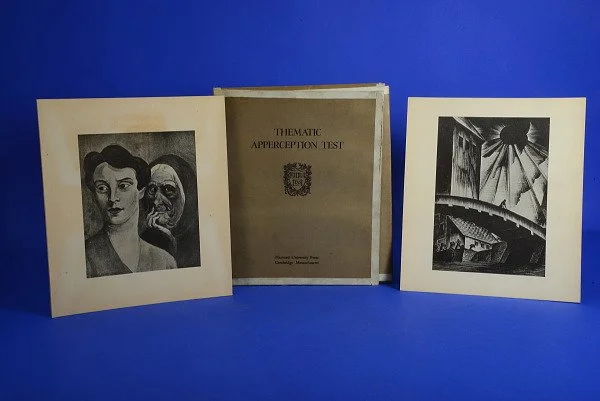
An example of Henry Murray’s Thematic Apperception Tests (picture from the NMAH)
Apperceptive Distortion
In psychology, there is a concept called Apperceptive Distortion. In the 1930s, psychologist Henry Murray developed the Thematic Apperception Test (TAT). He would show patients highly ambiguous images—a shadowy figure in a doorway, a person looking out a window—and ask them to describe what was happening.
Because the image lacked a neat, defined ‘story’, the patients had to rely on their own internal state to fill the Information Gap. A depressed patient saw a tragedy. An anxious patient saw a threat. They projected their own psychology onto the ambiguous external stimuli.
The real world is no different. When you lift the camera, you are taking a Rorschach test. The visual breadcrumbs you instinctively choose to include—and the context you choose to crop out—are direct projections of your internal architecture at that moment.
If you are feeling isolated, you will subconsciously hunt for a solitary figure against a vast wall. If you are feeling overwhelmed, you might lock onto frantic geometry and high-contrast friction. You think you are finding the signal in the scene, but you are actually just tapping into the signal within.

How different would this picture have been if I’d been in a different mood?
The Body’s Feedback Loop
In a landmark behavioural study, psychologist Fritz Strack and his colleagues asked participants to hold a pencil in their mouths in two different ways.
One group held it between their teeth, which physically forced their facial muscles into a smile. The other group held it between their lips, forcing a frown. They were then shown cartoons. The group forced to "smile" found the cartoons significantly funnier.
The conclusion is profound: our physical state dictates our emotional reality.
When you are shivering in the sleet, or when the dust of a corrugated track has worn your patience down to nothing, that physical friction alters your brain chemistry. Your discomfort dictates your emotion, and your emotion influences the image you take.
You cannot separate the physical exhaustion from the visual intelligence of the final frame. They are the same thing.

What does this picture reveal about the photographer?
Reading Your Own Rorschach
The next time you open a grid of raw files, ignore the subjects. Look at the structure of the frame. Your photographs are not just records of where you have been, they are records of who you were at the time.
Look. In truth, this may not change the way you shoot, but I do think it will change the way you see.
When you realise you aren’t capturing ‘truth’, but instead realise that a picture is a way to bring your unique self into the world… that is a powerful force of creativity.
And remember this. The most powerful, arresting photographs in history were never objective. They are the ones where the photographer’s internal state bled out leaving a pure, undeniable signal of who they were.
If you are tired of capturing the objective and want to learn how to inject weight into your work, it’s time to upgrade your visual intelligence
👉 Download my FREE Visual Intelligence Blueprints here.

What will my next pictures reveal about me?