
The industry’s favourite buzzword is ruining your work. Here is the science that solves it.
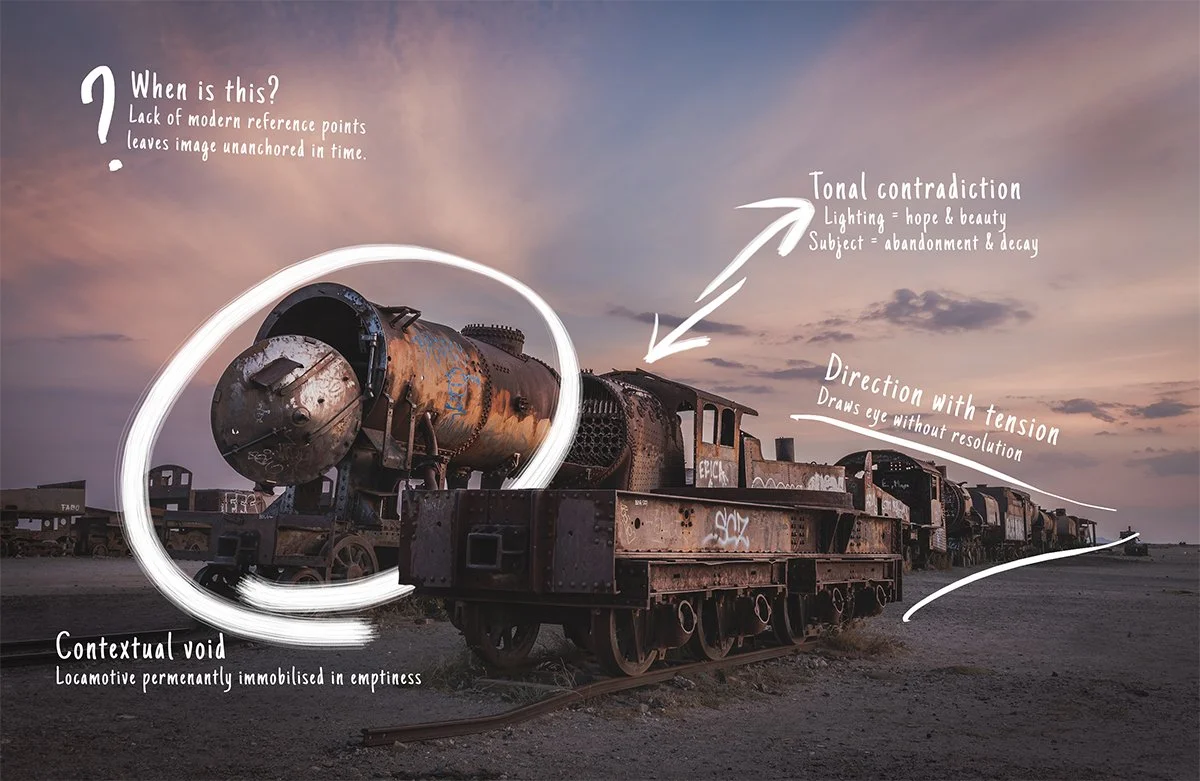
Uyuni, Bolivia. A machine designed for motion, abandoned in stillness. By withholding the 'why', we force the viewer's brain to engage with the evidence
I’ve spent years navigating the edges of the map—from the dust of the Sahara to the high passes of the Himalayas. But for too long I was bringing back images that didn’t grab people, pictures that didn’t tug at emotions.
I was stuck in the "storytelling" trap.
Like most photographers, I was conditioned to believe that my goal was to tell a story. I spent my time trying to understand how to translate the abstract notions of story that “photography gurus” would talk about into 1/500th of a second.
The harder I tried to be a storyteller, the more I missed the reality - and the opportunities to capture the real magic - happening right in front of my lens.
The breakthrough came when I applied my background in behavioural psychology to the camera. The reality became obvious and simple:
“You cannot photograph a story; you can only photograph the signals that trigger one in the viewer.”
The Myth of the Narrator
Why is it impossible for a photograph to tell a story?
A story requires time. Stories require a sequence—a beginning, middle and end. A photograph gives the brain a frozen 1/250th of a second. There is no before, no after.
Stories create clichés. When you hunt for a "story," you rely on top-down expectations. You shoot what you think you should see, blinding yourself to the raw reality in front of you.
Viewers don't want your story. When you try to curate a story - and spoon-feed - your viewers, you rob them of the dopamine hit of discovery they are after.
So then, what is a Signal? Think of it as a visual shorthand. A specific, tangible cue in your frame—an averted gaze, a body’s physical strain, or an unanswered shadow—that suggests meaning without spelling it out.
You are not writing a novel for the viewer; you are leaving breadcrumbs for their mind. When you build your frame around strong signals, you stop taking snapshots and start giving the viewer’s brain the evidence it needs to feel something.
The Science of the ‘Signal’
Visual perception happens in a strict hierarchy:
1. The Eye Grabs the Signal (Bottom-Up)
Before a viewer thinks a single conscious thought about a "story," their visual cortex builds a Saliency Map—an automatic priority list hardwired to hunt for raw cues like contrast and luminance. The viewer doesn't choose to look at these; their biology forces them to.
2. The Mind Builds the Story (Top-Down)
Only after those signals are locked in do higher-order brain centres kick in to construct meaning. In landmark research at Harvard, psychologist Henry Murray proved this with ambiguous visual tests: people don't describe what is literally on the page—they project their own memories, fears, and history into the visual gaps.
When you try to spoon-feed a viewer a pre-baked story, you short-circuit this natural hierarchy.
But when you build your frame around strong, undeniable signals, you trigger it—giving the viewer's brain the raw evidence it needs to construct its own emotional story.

The Signal in the Frame is a science-backed operating manual for photographers
The Signal in the Frame: Photographer’s Operating Manual
Once you understand the neurological triggers, photography stops being a guessing game.
I spent years distilling research and field experience into a system for photographers who are tired of superficial rules and generic presets.
I call it the Signal in the Frame.
It’s a practical photography crash course, a framework rooted in science and a stronger, more consistent way to create emotive work to connect with your audience.
Here’s a free taste of what’s inside: five of the Signals, why they work and what to look for out in the field.
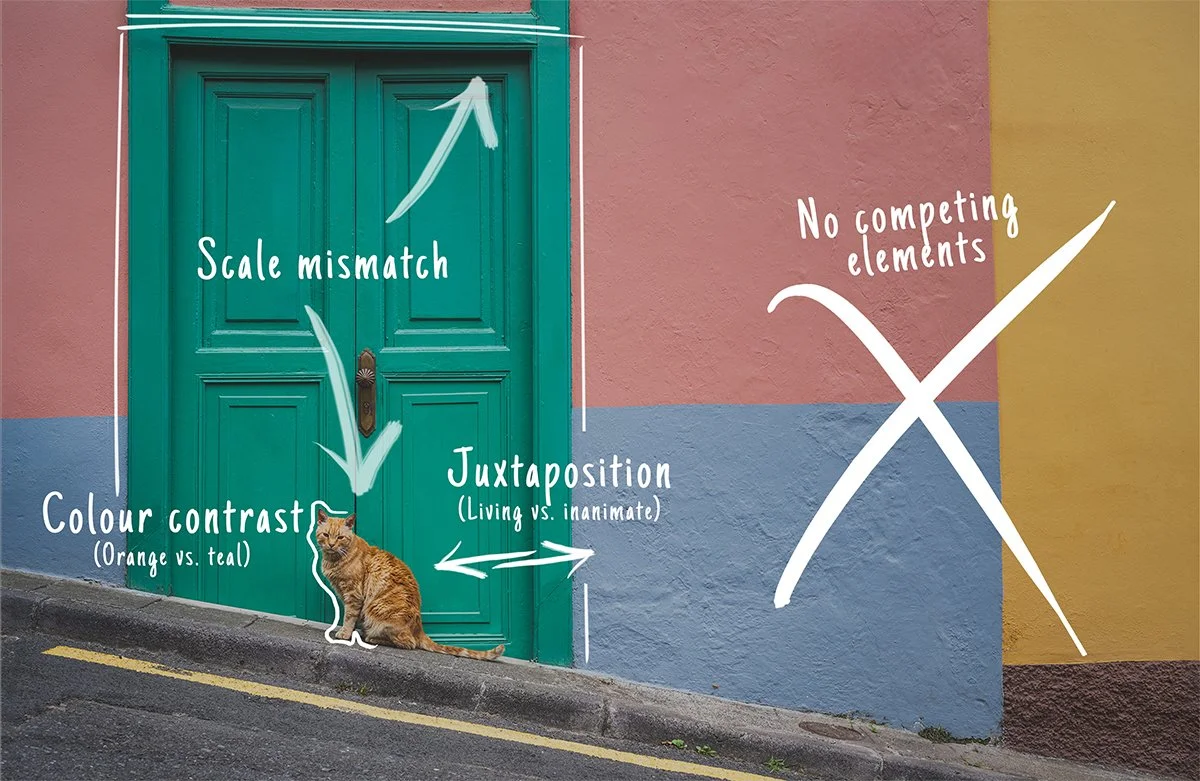
Tenerife. The orange of the cat sits in direct opposition to the teal of the door. This creates immediate prominence, pulling the eye before thought intervenes. Pop doesn't need help; it just needs space.
1. POP
The Science: Pop is where visual processing begins. Before your conscious mind registers what an object is, your brain scans for luminance and colour differences—it’s a survival mechanism once used to detect threats in the brush. When an element breaks the pattern, the brain snaps toward it.
How to capture POP? Look for isolation—a single living subject interrupting an inanimate texture, or a warm hue cutting cleanly across a cold, muted backdrop. Pop doesn't need complexity; it needs contrast and breathing room.
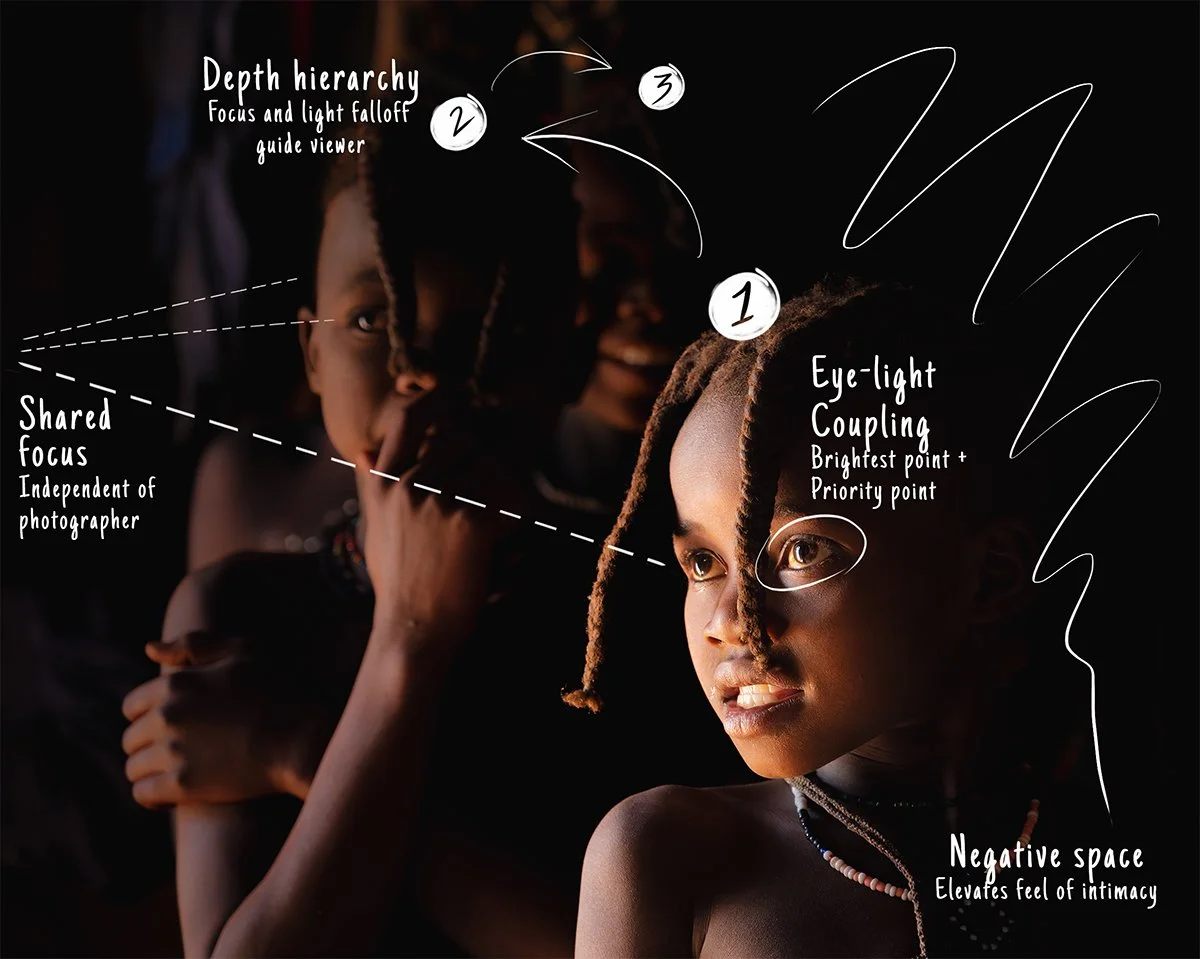
Namibia. By protecting the highlights in the eyes while letting the rest of the frame recede into darkness, we create a 'Hierarchy of Visibility' that slows down the viewer's perception.
2. GAZE
The Science: As a social species, we possess dedicated circuitry for detecting and interpreting eyes. When a viewer spots eyes in a frame, a hardwired mechanism called Joint Attention immediately forces their brain to look where the subject is looking.
How to capture GAZE? Resist the amateur urge to always grab direct eye contact. Hunt for the Averted Gaze—where a subject is intensely absorbed by something just outside the frame. This pulls the viewer’s imagination beyond the edges of the image, turning passive looking into active curiosity.
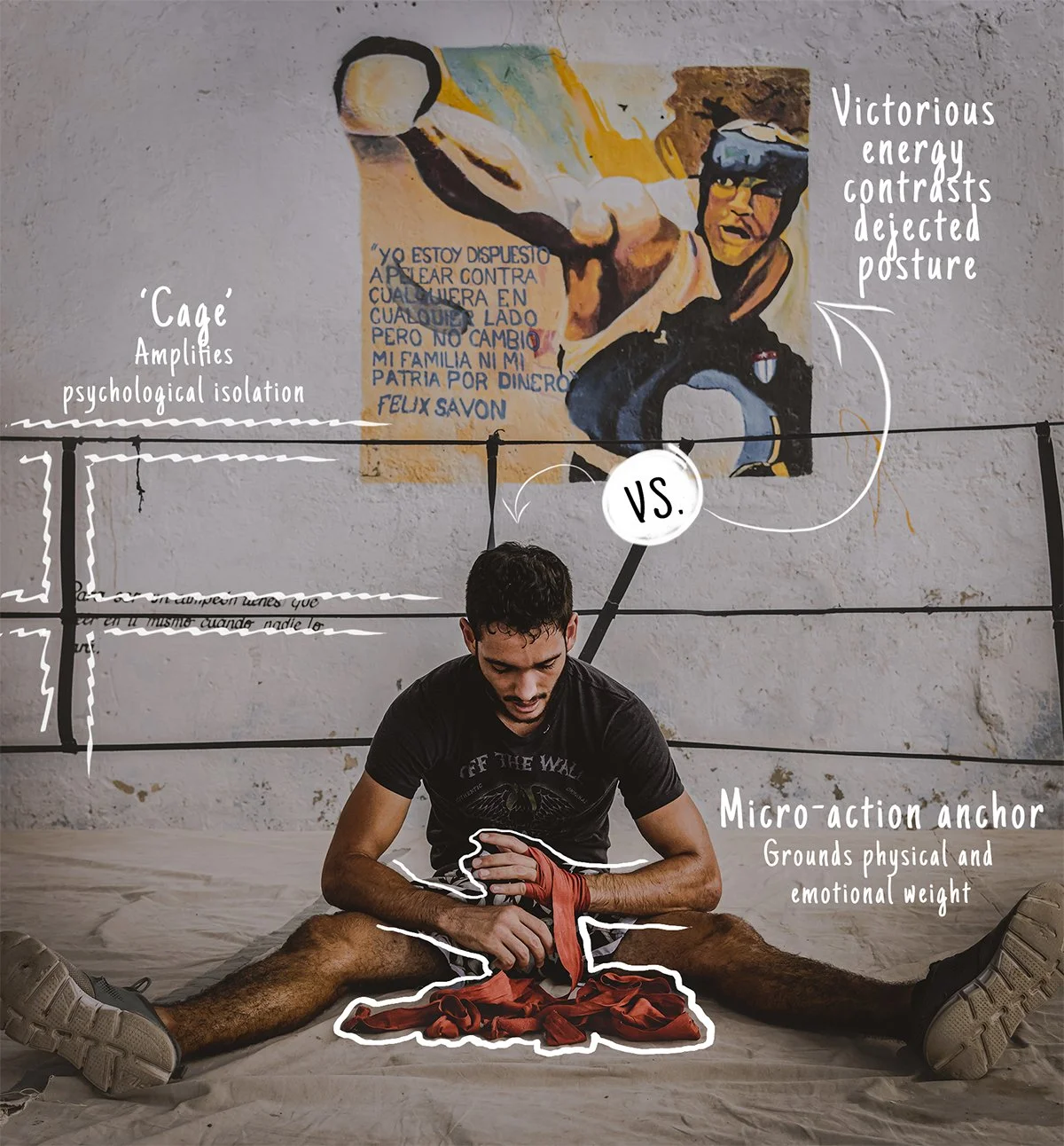
Havana, Cuba. The postural collapse of the fighter creates an emotional asymmetry that pulls the viewer inward. Impactful photos are where the biological cost of the moment is physically visible.
3. CHARGE
The Science: Charge is about emotional energy. Brain cells fire not only when you perform an action, but when you watch someone else perform it (it’s called the Mirror Neuron System). It means when you look at a photograph with high tension, your brain involuntarily simulates that physical strain in your own body.
How to capture CHARGE? Look for the physical aftermath of an event—a weary slump or a gripped hand—where the cost of the moment is written into the subject's muscles. If the physical toll is written into the subject, the viewer will feel it in their own gut.
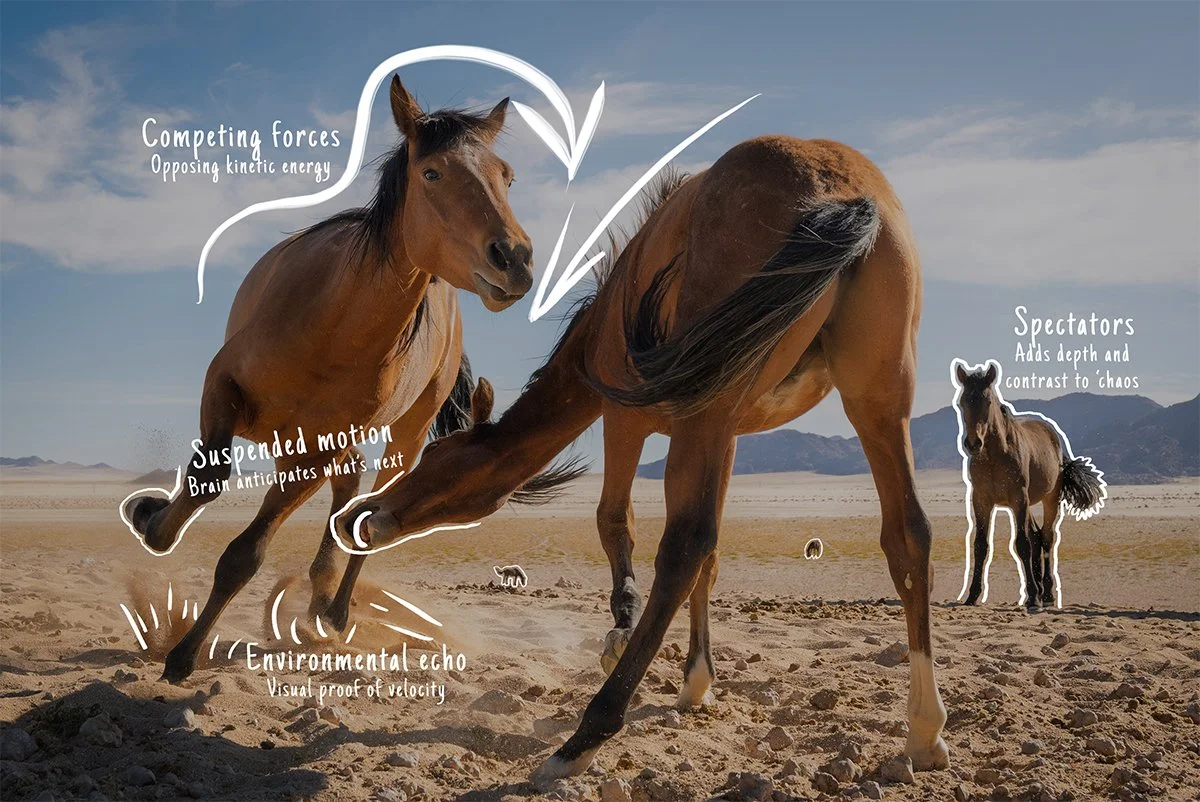
Namibia. By capturing the stallions at the peak of their movement, you trigger the brain's anticipation of what happens next. Resolution is the enemy of engagement; the power is in the transition.
4. SHIFT
The Science: The human brain is a prediction engine. It is constantly running simulations to forecast what will happen next. When you capture a subject mid-action, you create an unresolved equation. The brain is denied closure, forcing it to stay locked onto the frame to anticipate or try to resolve the outcome.
How to capture SHIFT? Hunt for the moment of peak disruption, like water suspended mid-air or hooves off the ground, where the movement is frozen but the resolution is delayed, forcing the eye to stay alert.
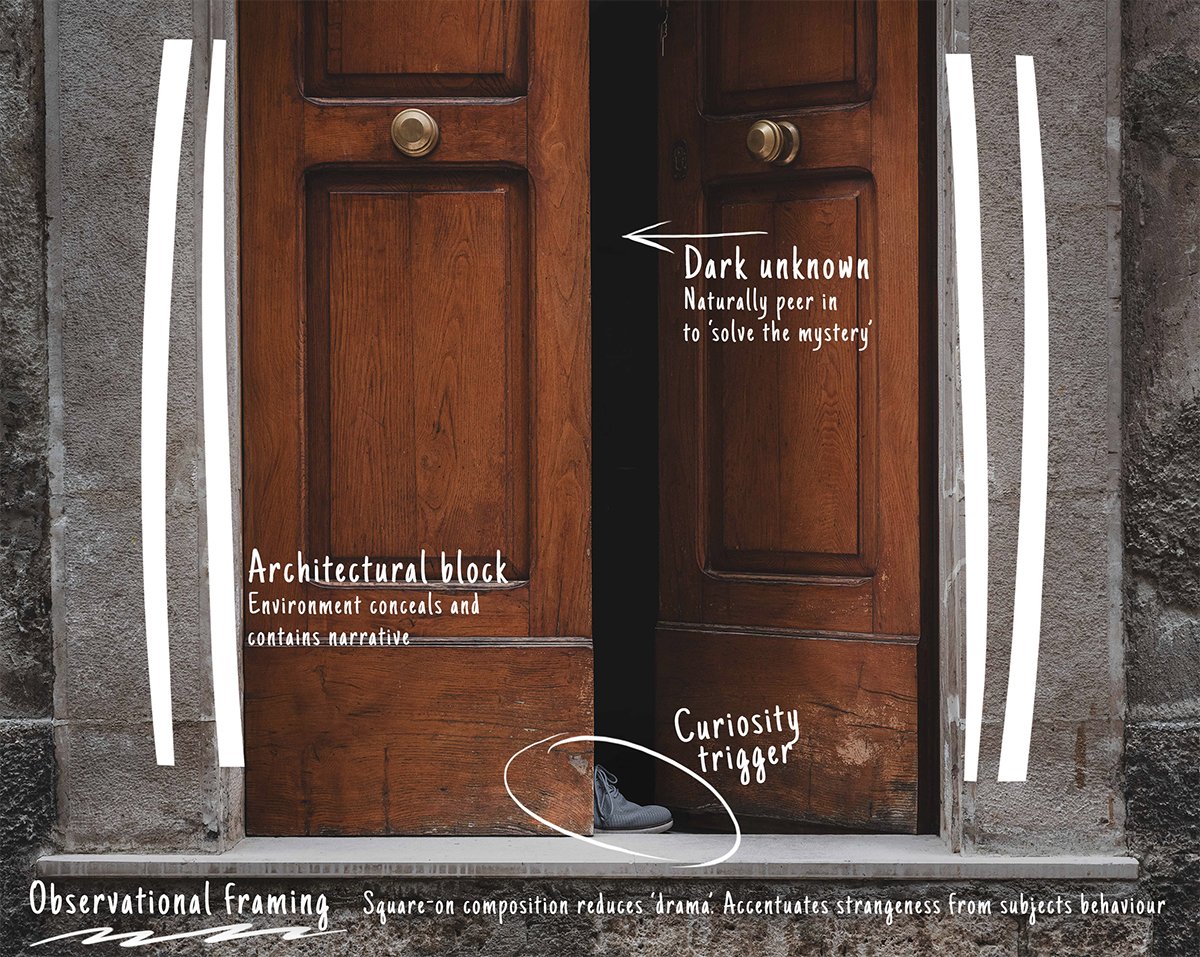
Scanno, Italy. A single shoe, a sliver of presence. By refusing to reveal identity, you transform the viewer from a passive passenger into an active participant.
5. AMBIGUITY: The Informational Gap
The Science: The brain despises an unanswered question—and that is your greatest weapon. In psychology, the mind desperately wants to fill in missing information. When you deliberately withhold context, you trigger a dopamine reward that only occurs when the viewer's brain is forced to ‘solve the visual puzzle’ itself (the Aesthetic Aha).
How to Capture it in the Field: Stop trying to explain the whole scene. Deliberately conceal parts of the subject behind doorways, deep shadows, reflections, or architectural frames. Show the clue, not the full answer. Force the viewer's imagination to complete the frame.
It’s as simple as seeing the signals.
Emotive photography isn’t about translating abstract notions of ‘story’ into a 3:2.
It’s about recognising the signals in the frame that spark a sense of story in the viewer.
That’s it. It’s that simple.
And when you start seeing those signals, trust me, you won’t be able to stop.
Are you ready to draw your viewers in?
I have spent years translating the complexities of human psychology into The Signal in the Frame—the definitive step-by-step breakdown of the Signals that underpin powerful photographs. 👉 Get The Signal in the Frame here

Your hard drive shouldn't be a cemetery of sketches; it should be a gallery of signals. Train your eye to notice the 7 cues that command human attention.