
The secret to photographs viewers fall in love with.

Pedras Negras, Angola. A single visual signal grabs attention. Layering them builds depth you can’t scroll past. Runner-Up, Africa Geographic Photographer of the Year.
Think of the photographs that have stopped you dead in your tracks.
Not the ones you gave a polite, passing nod to while scrolling on your phone, but the ones you returned to. The ones you stared at, discovering new relationships every time your eyes traveled across the frame.
Why do those images have such staying power?
In my framework, The Signal in the Frame, I dissect photography in relation to the signals our brain is hardwired to respond to: the magnetism of the eyes (Gaze), the tension of a posture (Charge), or why mystery is such a powerful tool (Ambiguity). It is Signals that capture attention and keep viewers engaged.
When you curate photographs around a single signal, you make clean, punchy, impactful work. A solitary figure in sharp side-light, or a lone animal locked in direct eye contact, cuts straight through visual noise.
A single signal is like a clean, solitary note played on a trumpet: it is clear, commanding and attention-grabbing.
But the photographs people truly remember don’t just play a single note.
They strike a chord.
They layer multiple signals into a 3:2 rectangle—not by cramming more clutter into the frame, but by curating the signals that tap deeply into our minds.
The Clutter Trap
Every photography student is taught the rule of "layering."
Put a rock in the foreground, place your subject in the mid-ground and let a mountain sit in the background.
It sounds logical but it can just result in objects jammed into the viewfinder rather than thinking about the kind of emotional depth you want to create.
Dr. Jeremy Wolfe from Harvard demonstrated that human vision does not scan a scene but instead rapidly pools different elements—luminance, colour, and shape—into a "Priority Map" that dictates where our eyes involuntarily jump next. You can curate a scene to take advantage of this priority map.
Further, Dr. V.S. Ramachandran proved that the brain experiences a profound aesthetic reward from the moment it sees distinct visual cues lock together and reveal a deeper, unified meaning.
When you successfully layer signals, you play into human psychology and choreograph that reward.

Kunene, Namibia. Layering human signals. The eye enters through the raking highlight on the foreground child (Pop), is redirected across divergent eye lines (Gaze), and is held by the contemplative hand-to-chin posture (Charge) against an impenetrable wall of shadow (Ambiguity).
Study 1: The Human Harmony
Look at this intimate frame of three young Himba children huddled together in the dark interior of a traditional hut. This frame has staying power because four signals are working in concert:
Pop: A single shaft of morning light enters from the left, raking across the profile of the foreground child. That high-contrast on the skin provides a clear gateway into the image.
Gaze: Notice the eyes. They catch the brightest available light in the frame and are a primary signal for the ‘priority map’. All visible eyes are averted, oriented toward the same off-frame point. We instinctively follow this and it makes us question, “what is pulling their attention?”
Charge: Look at the middle child’s hand gently resting against their chin and mouth. The foreground child in rapt attention, the background child has the start of a laugh just visible in their face. Those subtle cues trigger our mirror neurons. Together they communicate vulnerability, hesitation and innocence. You don’t just observe the children; your body registers their hushed, watchful stillness.
Ambiguity: Finally, look at what is missing. The background is entirely swallowed by deep, inky shadows. You cannot see the walls of the hut. You cannot see what the children are looking at. There are many unknowns and the frame only hints with scattered visual breadcrumbs. They force the viewer's imagination to supply the intimacy of the space.
This image doesn't just show you three children; it’s a journey through a childhood sanctuary.
Pop gets the viewer through the door. Gaze pulls you across the children's faces, Charge triggers a quiet tenderness and Ambiguity wraps the entire moment in sacred shadow.
You don't just look at the photo—your heart gets trapped inside it.

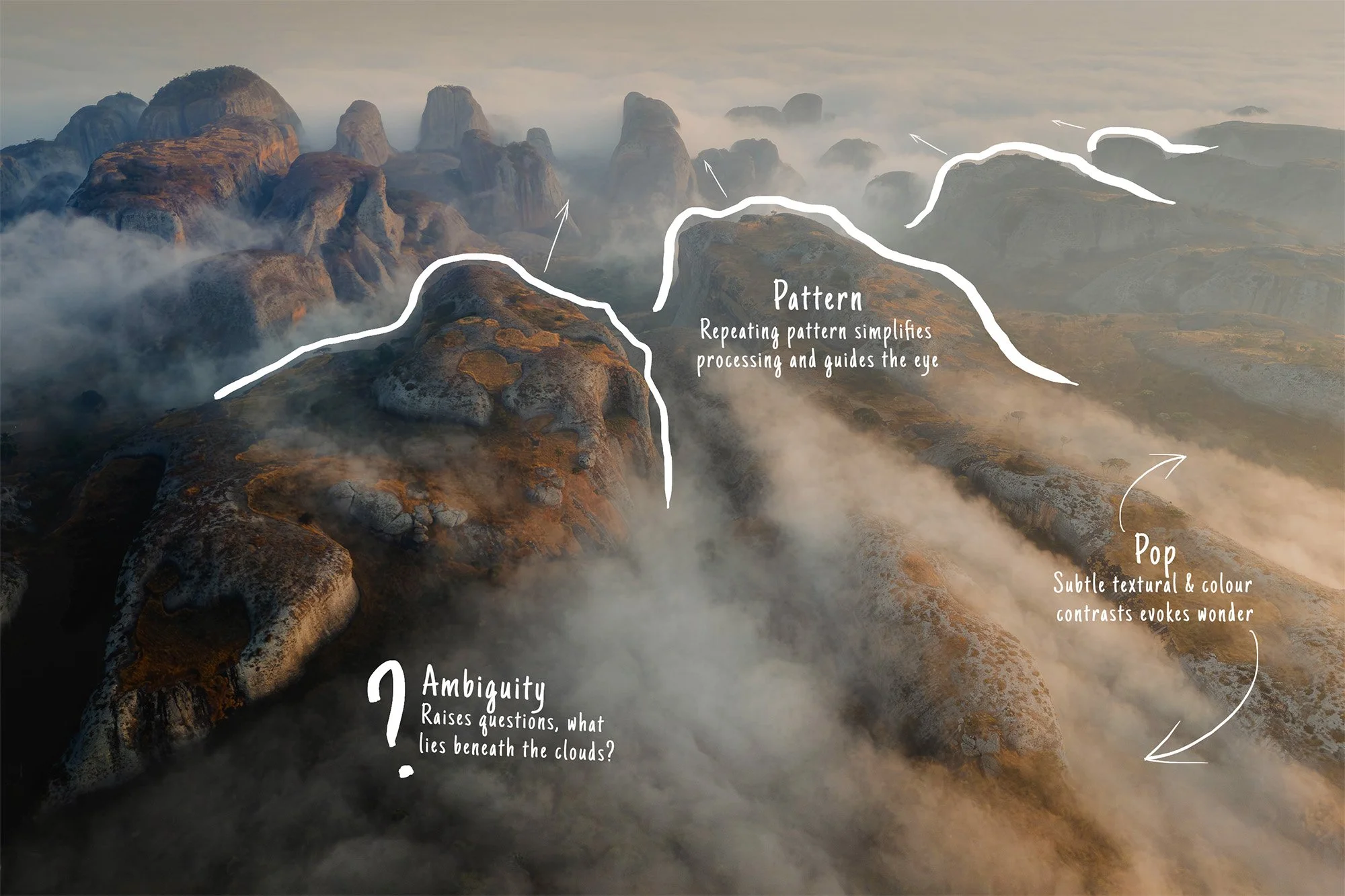
Pedras Negras, Angola. Layering environmental signals. The eye is drawn in by textural contrast (Pop), guided by the flow (Pattern), and held by the surreal illusion of ancient islands rising from an ocean of cloud (Ambiguity).
Study 2: A Mountain Symphony
The Signals of great photography don’t exist within a single genre. You can apply them across genres and when you start to see them you can’t stop. That is the power of understanding how our minds work and the impact layering Signals has on your work.
Earlier this year, this aerial photograph of the Pedras Negras, Angola was awarded Runner-Up in the Africa Geographic Photographer of the Year.
I had camped at the base of the rock formations in Sully, my Land Rover, and woke at 5:00 AM to a thick, suffocating ground fog. It would have been easy to go back to bed thinking all was lost, but instead I launched my drone straight up through the cloud deck.
When the camera punched through the mist into the first rays of dawn, the landscape on the monitor was completely surreal. I spent the morning watching the light evolve and searching the landscape for a frame that could capture the feeling of being there.
This image works because three core signals align in a single visual chord:
Pop: Pop here is different. It isn’t a Pop of strong contrast. Instead it is a pop of subtle textures and colours - the differences between the ancient weathered rock, the flora and the swirling clouds. They draw you in rather than ‘hit-you-between-the-eyes’
Pattern: Pattern in photography is powerful because the human mind likes repetition - it makes it relax and the image easier to process. This image works because there is repetition of rock and cloud from left to right, but also the foreground rocks lead to a cluster of rocks in the background. They help the mind relax and guide the eye.
Ambiguity: This is more than a dramatic landscape. It is an enduring mystery. The cloud deck deceives the brain's predictive engine, it makes us ask questions: Are these islands rising out of an ocean, or mountain peaks on a plateau? The mind is compelled to linger and resolve the riddle of the terrain.
Their mind is compelled to linger in the mystery of deep time and silence.
Pop is subtle, a painterly feel that draws you in, where Pattern takes over and guides the viewer through the image and further into it’s intricacies. Then, Ambiguity turns a blanket of morning mist into a surreal, dreamlike ocean.
It’s not just a drone shot. It’s an encounter with something timeless.

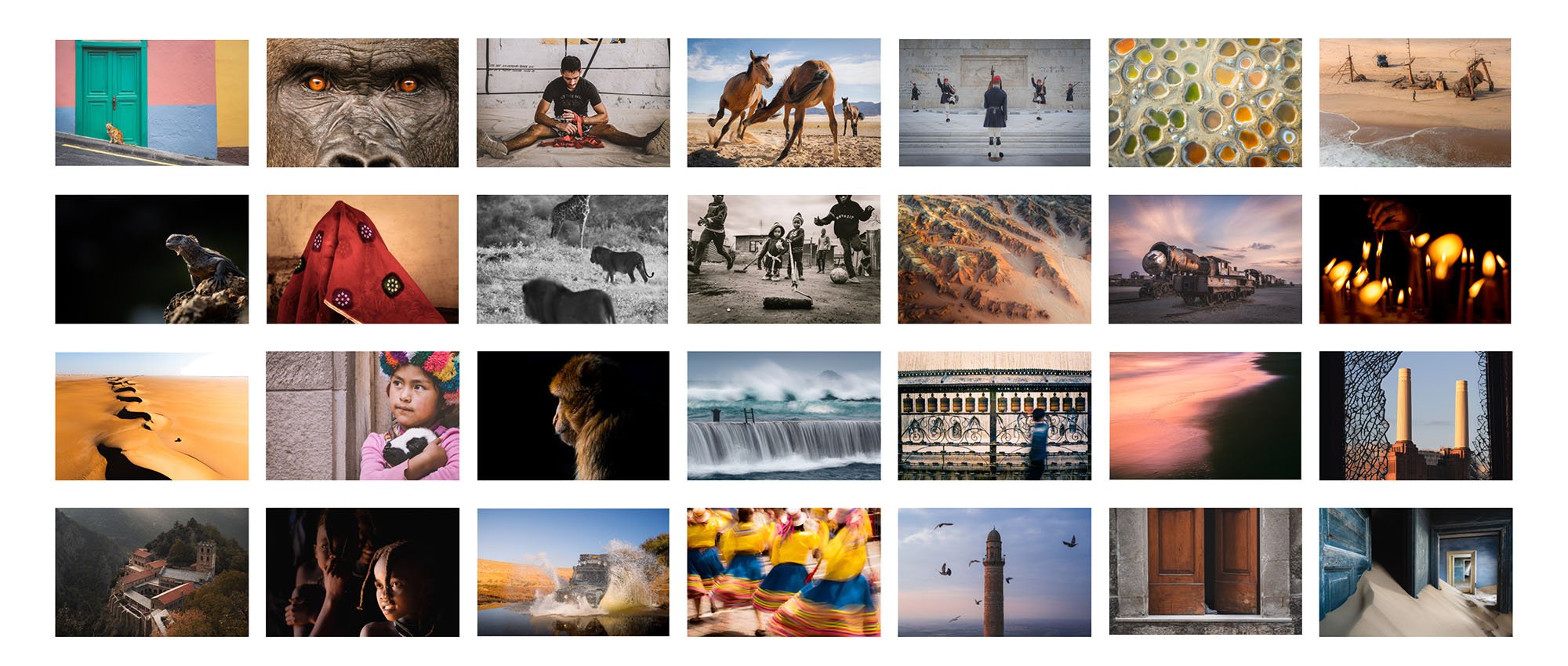
The visual grammar of emotion. Every compelling photograph across genres—from street to wildlife—relies on the same underlying Signals
So What: 3 Tips for Layering Signals
Define the priority Signal: If you have a powerful human gaze, don't pair it with a screaming, hyper-saturated neon sign in the background. If two strong signals fight for dominance, you dilute the song you are creating. One signal must be the clear conductor; the other signals must act as the backing instruments.
Pair a Fast Signal with a Slow Signal: The most reliable formula for emotional depth is pairing an immediate, bottom-up signal (Pop) with a reflective, cognitive one (Ambiguity). The first gets the attention; the second earns the memory.
Use Negative Space as the Conductor: Notice what both the Himba and Pedras Negras frames have in common: room to breath. The mother and child are surrounded by a sea of deep, quiet shadow; the mountains with mist. Negative space isn't wasted space—it is the silence between the notes that allows the chord to ring out.
Master the Architecture of the Frame
Great photography isn’t an accident, and it isn’t a composition formula. It is the deliberate craft of understanding how visual triggers interact with the human mind. The Signals that it sends.
If you are ready to master the complete system to curating powerful, multi-layered photographs:

The Signal in the Frame is a science-backed operating manual designed to turn deliberate study into effortless creative instinct.