
Stop Photographing Nouns. Start Photographing Verbs.
Discover the neuroscience of why the best images have nothing to do with your subject

Dawn in Cappadocia. The signal isn't the balloon or the vehicle; it's the relationship between them
I’m standing on a limestone ridge in Cappadocia, Türkiye at 5:00 AM. My hands are numb from the pre-dawn cold, and the air is sharp with the smell of woodsmoke from the valley below.
As the sun breaches the horizon, the silence is broken by the roar of burners. Dozens of hot air balloons begin to rise into the violet sky.
It’s a scene I’ve seen a thousand times in magazines, and my first instinct is to do what I used to do: find a "hero subject" and photograph it.
I used to think finding the perfect subject—the Noun—was the key to great photography.
But looking back at those early frames, I realise now they felt oddly sterile. They were records of something, but they had no pulse; no soul. They didn't capture a tension or a scale to give the image life.
In Cappadocia I was reflecting on this: we spend so much time hunting for "subjects" that we can so easily miss the connections that give a subject ‘life’.
The Subject Trap
The photography industry guides us to find a beautiful model, a dramatic mountain, a classic subject.
In linguistics, these are Nouns.
Nouns are static. From a neurological standpoint, nouns are also a bit boring. Your brain is so efficient at identifying objects (a "balloon," a "car," a "rock") that it labels them in milliseconds and then stops paying attention.
True Visual Intelligence isn't found in the Noun. It is found in the Verb.
The Verb is the action.
It is the tension.
It is the relationship between things.
The signal isn't "the balloon"; the signal is found in "the balloon looming over the valley," or "the balloon hiding behind a ridge."
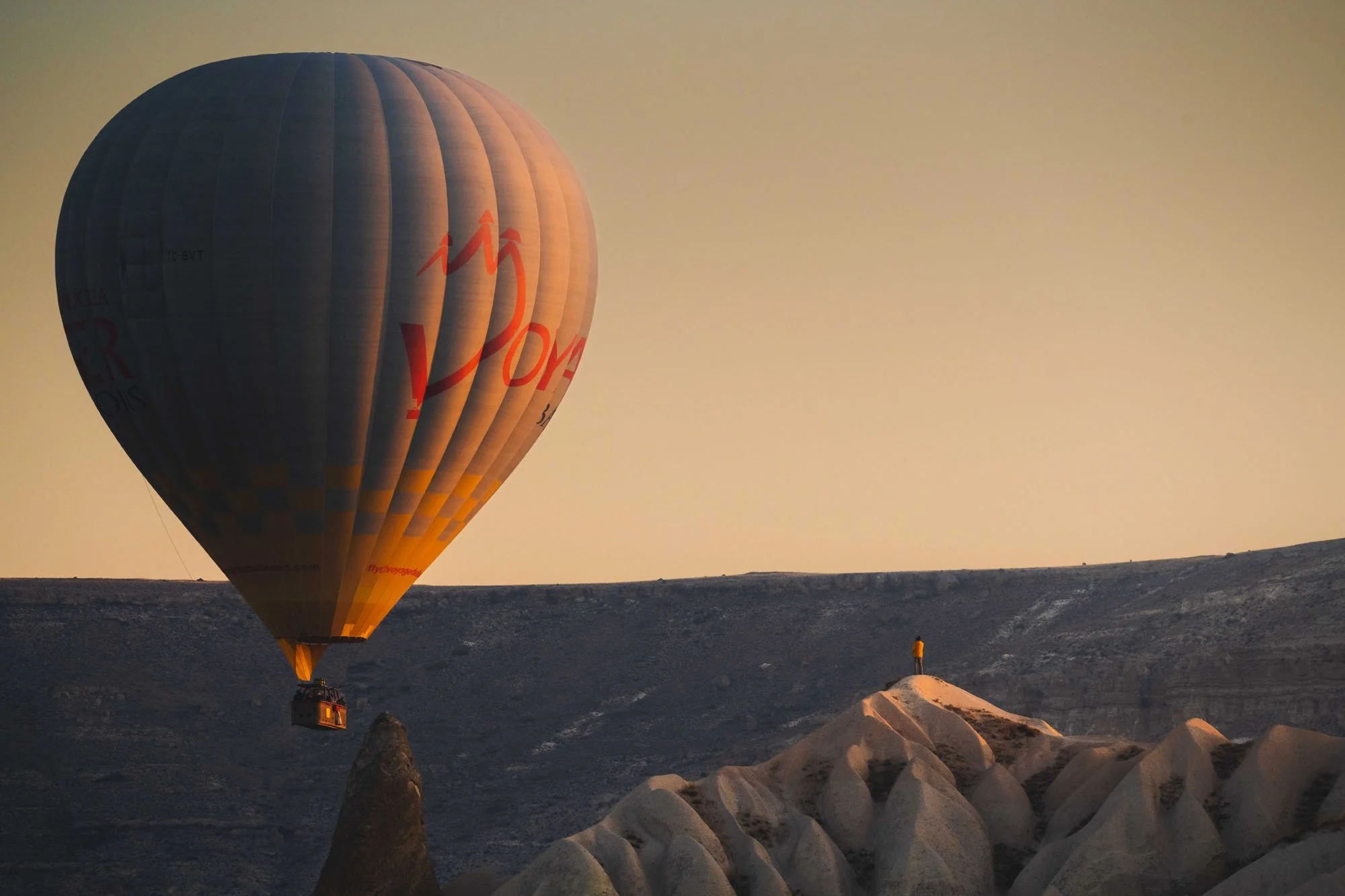
Finding the signal in the cold. The early hot air balloons provide a primary visual fact, but the art is in the relationship they form with the landscape.
The Neuroscience of Relationships
To understand why Nouns often feel sterile, we have to look at how our visual cortex processes the world.
In behavioural psychology, there is a concept known as Relational Processing. Recent research, including a seminal review by Hafri and Firestone, proves that our brains have a dedicated neural architecture for "seeing relations".
We don't just see two objects and then think about how they relate. Our brain perceives the relationship itself as a primary visual fact, often within milliseconds.
Evolutionarily, this is a survival mechanism. Our ancestors didn't just see a "predator" (Noun); they saw a "predator approaching a child" (Verb). The relationship was vital intelligence.
When you isolate a subject and blur the background, you are essentially deleting the Verb.
You are giving the viewer a word without a sentence.
Visual Intelligence in Cappadocia
Using the chaos of Cappadocia as a laboratory, we can see how shifting from Nouns to Verbs transforms an image and creates powerful work.

The Verb here is 'Escaping'. The relationship between the cold, dark interior of the cave and the sun-drenched balloons triggers a biological response.

The Verb is 'Dwarfing'. By placing the micro-speck of the Land Rover against the horizon, we force the brain to calculate the immensity of the space.

The Verb is 'Looming'. The relationship between the soft, round sphere and the sharp, weathered stone triggers the brain’s relational processing.
How to Shoot the Verb
How do we practically apply this shift when we’re out in the field? It starts with changing the question you ask yourself behind the viewfinder.
1. Hunt for the Friction
Stop looking for the prettiest subject.
Look for the clash.
Look for the small object next to the massive one. Look for the modern object next to the ancient one.
2. Stop Using Bokeh as a Crutch
The instinct to blur the background to "clean up" the subject is a relationship killer.
When you blur the environment, you are severing the connection. You are deleting the Verb.
Stop trying to clean the frame; start trying to connect it.
3. Edit for the Signal, Not the Object
When you sit at your monitor, ignore the sharpest or most colorful "Noun."
Find the frame where two elements are in a state of unresolved tension.
Find the frame where one thing is pushing, pulling, dwarfing, or hiding from another.
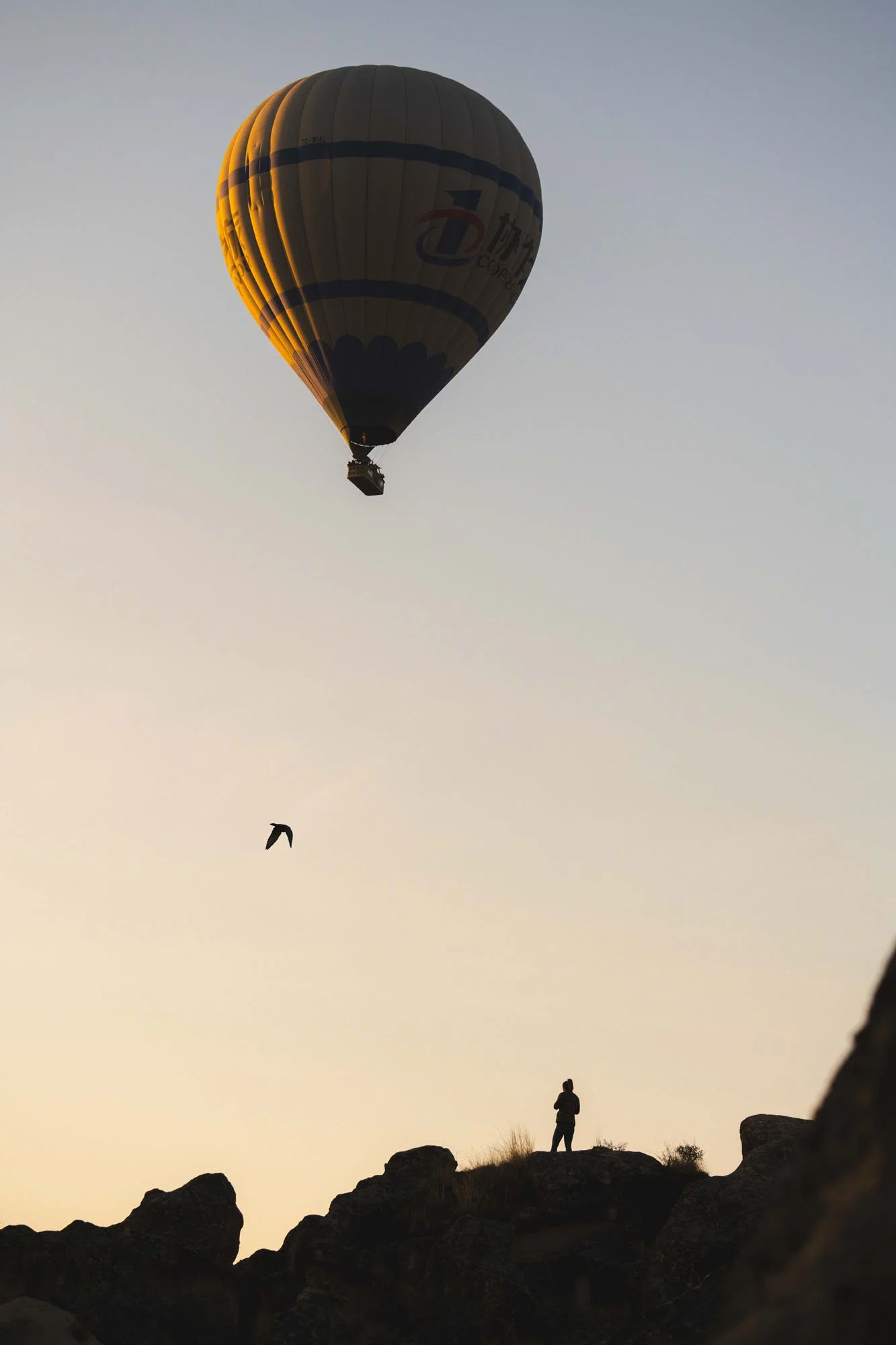
The Verb is 'Converging'. The alignment of the human, the bird, and the balloon creates a temporary triangle of tension that holds the viewer’s eye at the point of intersection.
The Final Signal
Your hard drive is likely full of beautiful Nouns. I know mine is. They are records of things you've seen, but they often lack the power to make a viewer feel the moment. You need to start being an observer of relationships.
The next time you raise your camera, think about it this way: the subject is just noise. The relationship is the signal.
Stop taking pictures of things. Start taking pictures of what things are doing to each other.
If you are tired of taking "pretty" photos and want to learn the psychological triggers that underpin powerful photography my field notes can help. 👉 Download my FREE Visual Intelligence Blueprints here.

Stop taking pictures of things. Start taking pictures of what things are doing to each other