
Want to take better photos? See like a baby.
Cognitive science proves your brain is too efficient to truly see. Here is how to reset it.
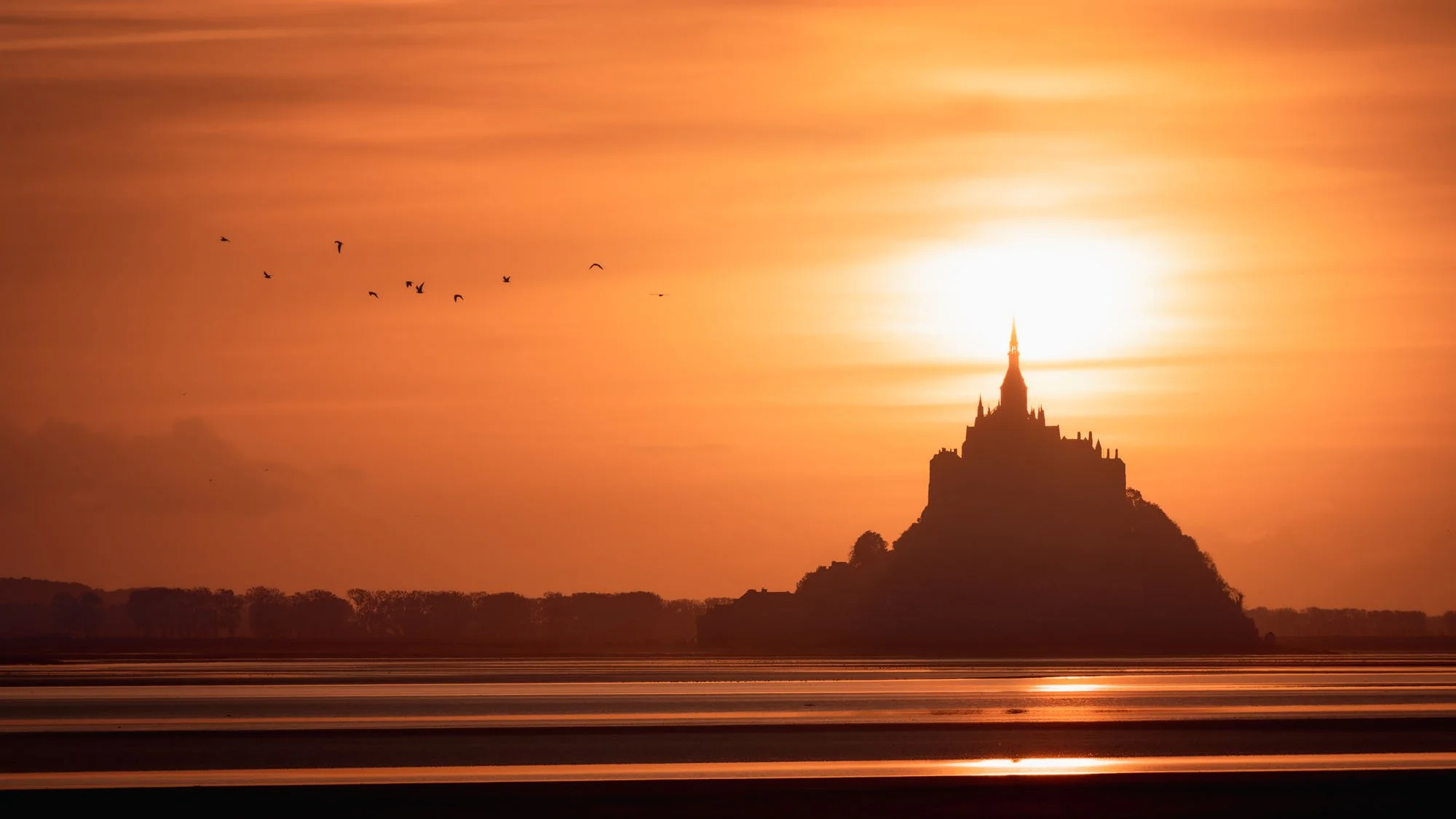
Mont Saint-Michel, France. The adult brain labels this "a castle at sunset." But when you strip away the noun, it becomes an exercise in luminance and silhouette
A reader named Steven recently left a comment on one of my articles that got me thinking.
He was reflecting on Predictive Processing—the theory that our brains actively predict reality. He described how an adult looking down a foggy street might momentarily mistake a large dog for a lion, or glance at a coiled garden hose in the grass and jump, convinced it’s a snake, until the brain catches up and corrects the prediction.
Then Steven made this observation:
“I think this explains why babies spend so much time just staring at stuff. They don't have shorthand models based on experience yet. They are building their experience archives. They have to take in the raw, unedited sensory data.”
Steven is spot on. And his observation uncovers a deep secret of photographic craft:
The biggest obstacle isn’t a lack of technical gear or creative talent. It is the fact that your adult brain has become too efficient to truly see.
Why Adults Photograph Labels
The human brain consumes roughly 20% of your body’s metabolic energy despite accounting for only 2% of its weight. To keep you from burning out, your brain is ruthless about conserving calories.
Cognitive scientist Dr. Andy Clark explored this and established how the brain operates as a Predictive Engine (Behavioural and Brain Sciences). Basically your visual cortex relies on heavy, baked-in mental models called "priors."
When you walk down a street, your brain doesn't bother analysing the subtle textures of the pavement, the angle of the shadow under an awning, or the rhythm of the windows. It glances at the scene, says “street”, projects its prediction and shuts down exhausting visual processing, unless an anomaly forces it to reassess.
This is why amateur photographers take boring photos. They raise the camera and photograph the label in their head ("sunset," "temple," "old man," "mountain"), rather than the raw, unscripted signals in front of their eyes.
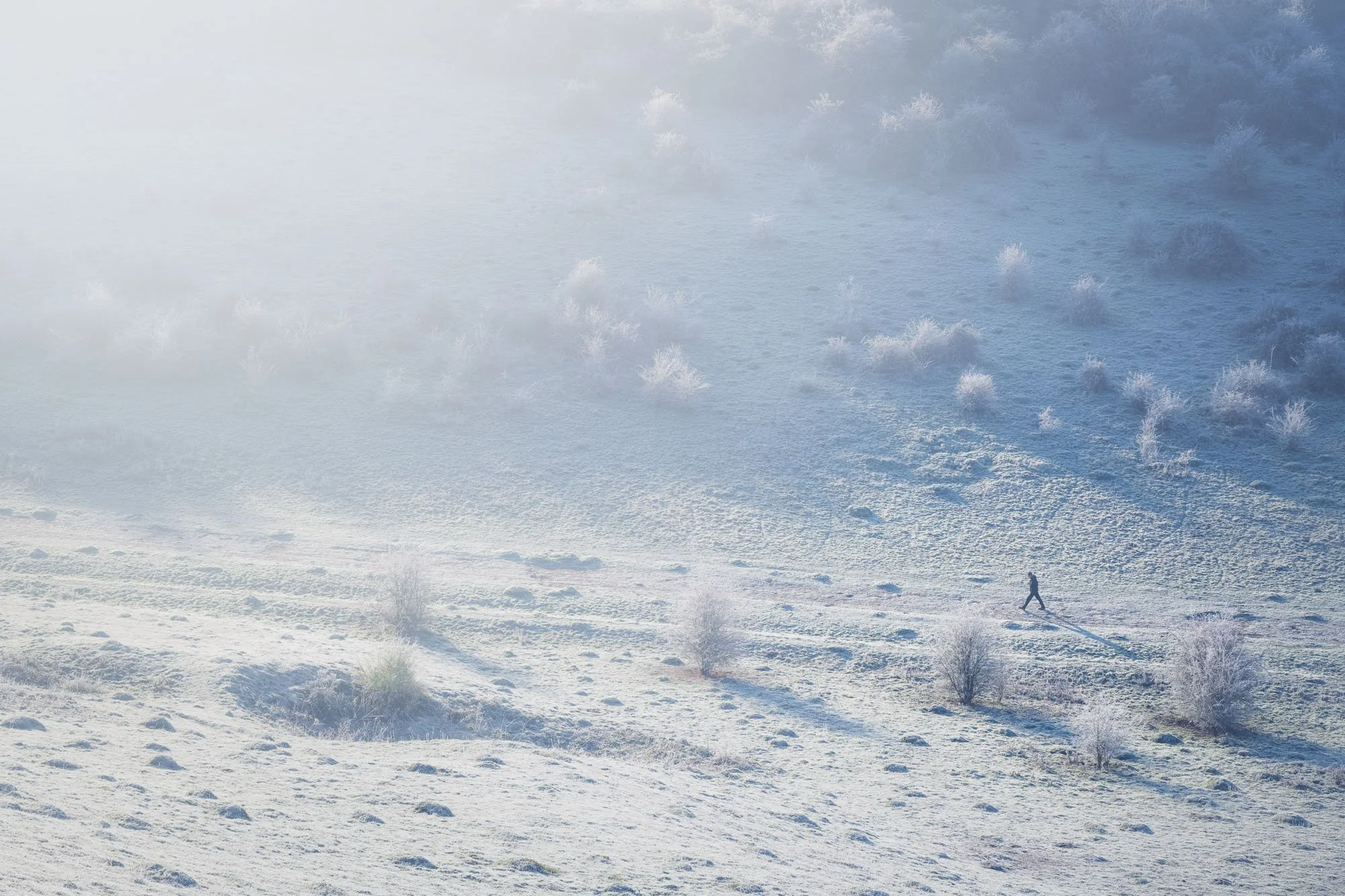
St. Catherine’s Hill, England. Spotlight attention hunts for a loud subject. Lantern attention diffuses across the frosty valley—noticing the lone, quiet walker only as an element of the greater landscape.
Spotlight vs. Lantern Attention
In groundbreaking developmental research Dr. Alison Gopnik demonstrated that adults and children operate on two entirely different attentional networks (Philosophical Transactions of the Royal Society B):
Adults have "Spotlight Attention": A narrow, highly focused, goal-driven beam of consciousness. Your brain filters out 99% of reality so you can execute a specific task—like driving a car, checking your phone or hunting for a photographic subject.
Infants have "Lantern Attention": Diffuse, wide-angle, panoramic awareness. Because babies have weak priors and no preconceived notions of what is "important," they don't filter out the world. A baby's consciousness is a lantern casting light in all directions simultaneously.
A baby stares at a blank wall for five minutes because they are mesmerized by the micro-texture of the plaster, the way dust motes dance in a sliver of light, or the subtle gradient between shadow and illumination.
They are absorbing the raw signals before language labels arrive to deaden the experience.
Great photographers aren't people with better cameras.
They are adults who have learned how to switch off the spotlight and turn on the lantern.
Field Studies: See Like an Infant
Whilst overlanding, I realised you shouldn’t be using your ‘Spotlight’ focus to hunt for a "subject." You should stand still, let your eyes unfocus and allow your lantern attention to take over:

Erg Maqheir, Mauritania. The adult prior says "sand dunes." The infant eye sees an abstract landscape of shifting tonal gradients, repeating S-curves and light.
1. Unlearning the "Desert" (Erg Maqheir, Mauritania)
The Adult Prior: When most photographers arrive in the Sahara, their adult brain locks onto the label: "the desert." They hunt for the stereotypical desert shot: a camel caravan, a dramatic ridge, or footprints in the sand.
The Infant Shift: By looking straight down from above the sand transformed into abstract shapes and movement. I stopped seeing sand and started seeing organic, sensual folds of shadow and light, as delicate as silk or skin.

London, England. By allowing horizontal motion to streak the twilight sky, famous landmarks dissolve into a graphic silhouette, leaving abstract bands of neon color and light.
2. Unlearning the "Skyline" (Greenwich, London)
The Adult Prior: Standing on a hill overlooking London, the adult brain’s spotlight immediately locks onto famous architecture: the Shard, the Gherkin, the financial towers. You see the postcard landmarks.
The Infant Shift: Through long exposure experimentation the changing sunset light meant the sky became a surreal, painterly canvas of horizontal neon stripes—magenta, violet, amber, and indigo. It was about the feeling of London, not documenting its reality.

Doğubayazıt, Türkiye. Lantern vision notices the dark, jagged negative space of the rocky void that gives the ancient stone its dramatic tension.
3. Unlearning "Postcard Architecture" (Ishak Pasha Palace, Türkiye)
The Adult Prior: Standing before a legendary 17th-century Ottoman palace, the adult spotlight instinct is to zoom in on the architectural masterpiece—the intricate dome, the carvings, the minaret.
The Infant Shift: Instead of pointing my lens directly at the building, I backed up into the mouth of a dark, rocky outcrop. I let my peripheral vision notice the massive, jagged void in the foreground. By letting deep shadow swallow 60% of the frame, the palace transformed into a sanctuary perched amongst the mountains.
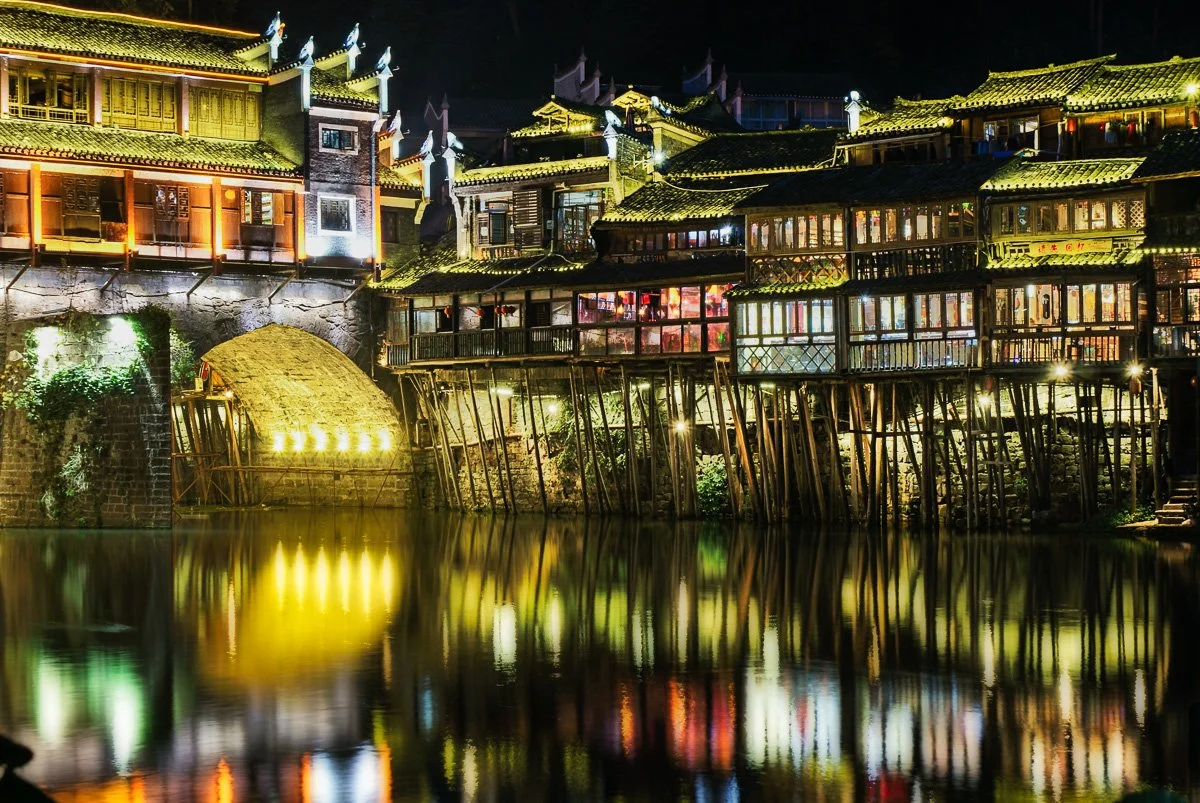
Fenghuang, China. The adult brain sees wooden houses on stilts. Lantern attention looks downward, captivated by the upside-down world of shimmering, liquid neon ribbons reflected in the dark river.
So What? 3 moves to activate Lantern Attention
Stop Naming What You See: The moment you whisper to yourself, "That's an ancient building”, or "That's a mountain", your brain stops looking at it. Force yourself to stop seeing "things". Look for cues, relationships, edges, light & dark and see what is revealed.
Hunt for the "Prediction Error": Walk through an environment and ask: What violates my expectations here?Look for the strange juxtaposition, the unexpected reflection, the shadow falling at an awkward angle. If it surprises your brain, it will grip the viewer's.
Soften Your Gaze Before You Shoot: Amateurs rush around squinting through the viewfinder, desperate to find something to shoot. Stop moving. Put the camera down. Soften your eyes and let your peripheral vision open up. Notice where the light is pooling on the ground, where motion is gathering on the edges and what the atmosphere physically feels like.
Adults see Labels. Babies see Signals.
Babies are mesmerised by the raw visual facts that our adult brains have learned to ignore: the unexpected contrast, the unresolved motion, the tension in a gesture.
This is why I created The Signal in the Frame.
Not as a rulebook or a technical checklist, but as a field guide to unlearning. It is designed to help you peel back adult assumptions, reopen your lantern attention, and spot the raw, hardwired visual cues that make an image come alive.
If you want to create work people can truly feel, explore the framework.

The Signal in the Frame is a field guide to stripping away adult clichés and rediscovering the raw visual signals beneath.