
The Myth of the ‘Story’: Why Your Best Photos Are Left Unfinished
The science of why ‘hinting’ at a narrative is 10x more powerful than trying to ‘tell a story’.

Is the story in the eyes of the photographer, or in the mind of the observer?
Photographers are obsessed with ‘storytelling’. It is the industry’s favourite cliché. We are told that a great photograph should hold a complete narrative within its four corners.
I’ve spent years traveling & photographing all over the world and I’ve come to realise that this idea is a myth. A single photograph cannot tell a story.
The reason is simple but often overlooked. Let’s step away from photography for just a moment.
Films, books, plays. These mediums of storytelling have one key thing that photographs don’t.
Time.
They happen over time. A film forces you to follow a sequence. A book dictates the pace of your discovery. Time is a key component of any story.
A photo? It’s a frozen slice of time. It’s completely different.
But what a photograph can do is far more potent: it can hint. It can open a door. It can force the viewer to become a co-author. That is photography’s uniqueness and a psychological superpower.
Alongside photography, I have spent 20 years applying behavioural science and psychology to understand what makes humans tick. Nowadays, I apply these principles to photography and the effect has been transformative for me and my students.
👉 Discover the cognitive operating manual for photographers.
Stop explaining the story. Start engineering the feeling.
You see, the most haunting, powerful and compelling images aren’t telling a story, they aren’t giving you all the answers; they are the ones that simply start you asking questions.
Here are three psychological truths as to why I recommend you stop ‘shooting for story’ and instead start ‘searching for signals’.
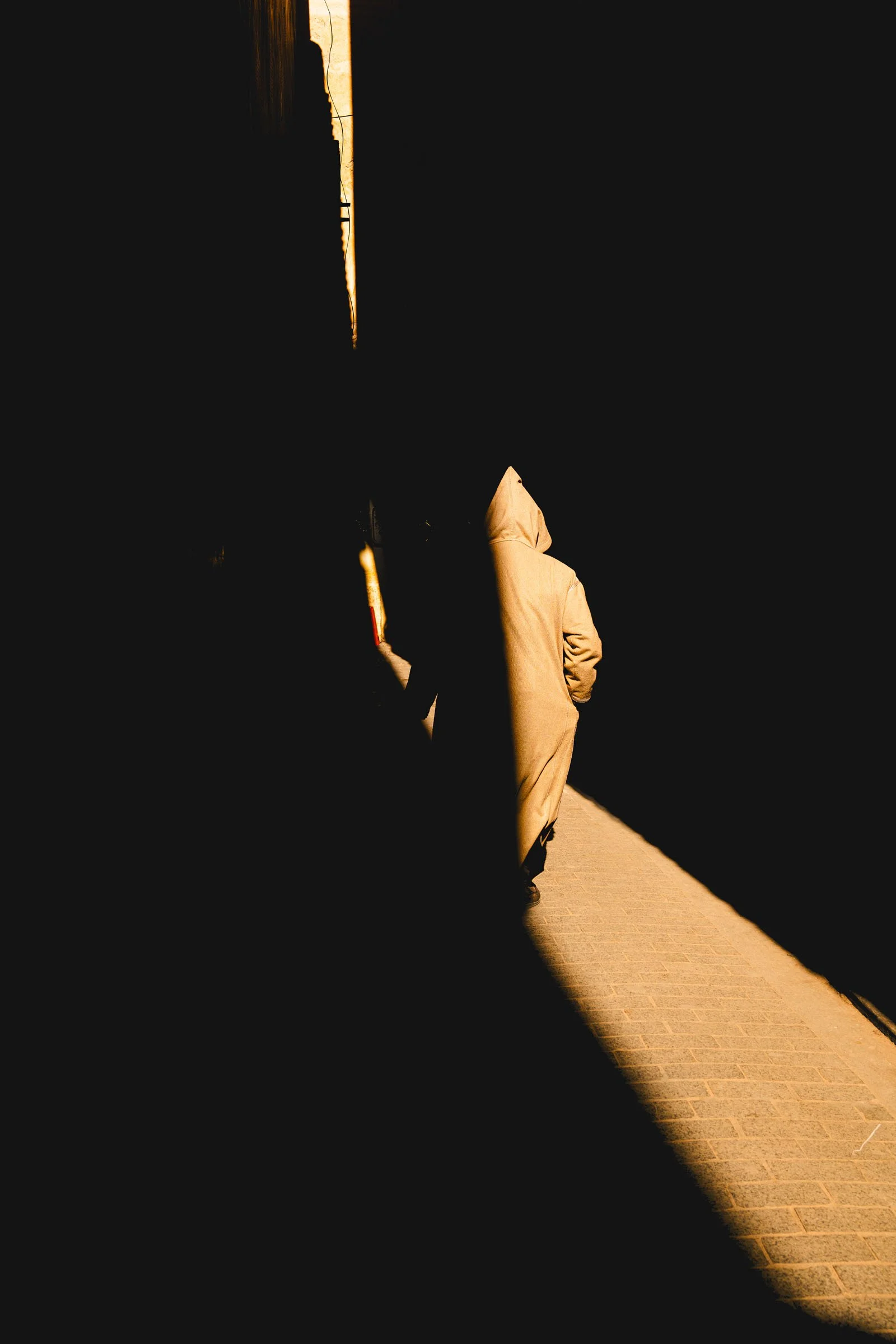
What will the viewer think about what remains hidden in the shadows?
1. The Information Gap: A Biological Itch we all want to scratch
There is a theory in psychology called the Information Gap. It argues that curiosity is not an intellectual choice as we often think of it but in fact a hardwired, visceral state. It is a biological drive within us as urgent (almost) as hunger or thirst.
When you look at an image that provides just enough data to hint at some element of story your brain’s reward-processing centre (the ventral striatum) lights up. In other words, the search for a story becomes as chemically pleasurable as finding it.
The mistake I see most photographers make is over-filling the gap. They try to provide 100% of the information. They show the face, the action and the outcome (and often in clinical high-definition, laying bare the shadows and all). The problem is this doesn’t reward the viewer, their “thirst” is immediately quenched and they move on.
To create impact, you must keep the gap open. You need an Information Gap. Provide the signal, but withhold the resolution. Force the viewer to itch.

Does this frame provide you with the answers, or are you the one building them?
2. The IKEA Effect: Why Labour Leads to Love
In 2012, researchers identified a principle they called the IKEA Effect. They found that people attribute significantly higher value to things they have ‘self-assembled’. Bear with me… this is relevant!
In their study, participants were willing to pay 63% more for furniture they built themselves than for the exact same items pre-assembled by experts.
Think about that when you are trying to ‘tell a story’ inside your frame. When you ‘pre-assemble’ the meaning of a photo — by making the subject obvious or the emotion too literal — you are effectively devaluing your work. You are handing the viewer a finished product that requires nothing from them.
Meanwhile, a ‘hinted’ photo is a DIY narrative kit.
When a viewer has to put in a bit of cognitive labour to ‘solve’ your visual puzzle, they develop a sense of ownership over that meaning. It is no longer your photograph; it is theirs. That is powerful. That is engagement.
By leaving the image slightly unfinished, you invite the viewer to finish it. That labour is the ‘secret sauce’ of powerful photography.

Do you see beauty or decay or something else entirely?
3. Apperceptive Distortion: The Psychological Mirror
At Harvard, researchers developed the Thematic Apperception Test (TAT). It’s a clinical tool used to quite literally prove that there is no such thing as an ‘objective’ story when it comes to an image.
When researchers show 100 people the same ambiguous photo of a person sitting alone in shadow, they get 100 different narrative origins. One person sees grief; another sees peace; yet another sees exhaustion.
This happens because of a psychological concept called Apperceptive Distortion. The brain uses its own history, motives, and fears to interpret the scene.
This is how we should all be thinking of every photograph we take.
It’s not a story. It’s a mirror. You are not a storyteller. You are a Curator.
The more you explain your work, the more you ‘shatter’ that mirror. The more you hint, the more the viewer can see their own life reflected in the frame.
As Anaïs Nin famously said: “We don’t see things as they are; we see them as we are”.

Why does your history dictate what you see in this silence?
Stop Explaining. Start Hinting.
Great photography is not an act of documentation. It is an act of extraction. It’s about engineering a moment that catalyses the viewer’s brain to start constructing.
The next time you’re behind the lens, don’t ask: “How can I show what’s happening here?”
Instead, ask: “What can I withhold to make the viewer wonder?”
Give them a signal, leave the gap open and force them to pay the price of entry to tell their story. That’s the secret to an image with impact.
Cliff is a Visual Ethnographer. With a background in psychology and behavioural science, he travels the Earth’s challenging environments to decode human psychology and capture that authenticity with his camera. If you’re tired of taking ‘postcard’ photos check out ‘The Signal in the Frame’ and if you want to join his Land Rover adventures, they can be found here.

If I told you the truth of this moment, would the photograph lose its power?